

Types of installation
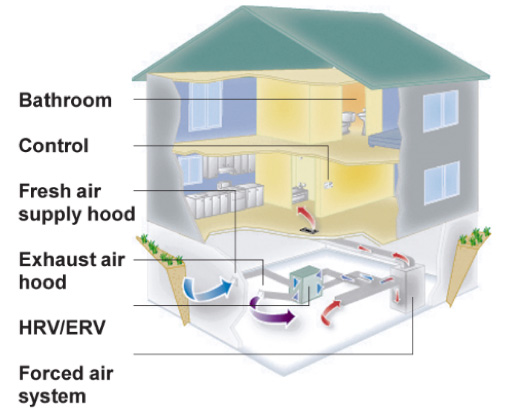
Exhaust and supply in return – Good
When using this application make sure that there is minimum 6 feet between the fresh air and exhaust air connections of the HRV or ERV in the return air duct. Supply air from HRV or ERV must be at least 3 feet from the forced air system. Can be different from a region to another. You should check with your local code or the forced air system’s manufacturer. CAUTION The HRV and forced air system must be in continuous mode, to achieve maximum comfort and to avoid cross-contamination. Due to temperature differential between unconditioned areas and the rest of the dwelling, all ducts must be fully insulated. The unconditioned areas temperature must always be above 0°C (32°F). NOTES Fresh air must always be down-stream from the exhaust air in the return air duct of the forced air system. Installation of an HRV/ERV is not recommended for unconditioned areas (attic or crawlspace)
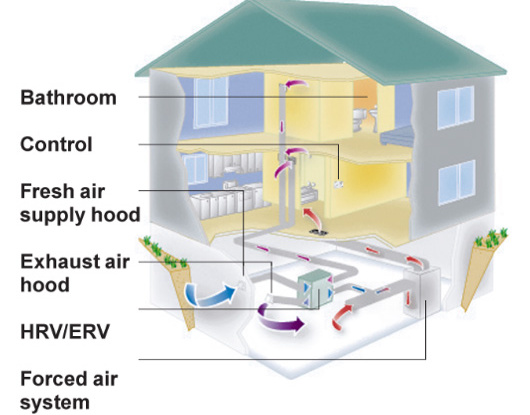
Exhaust at the source and supply in the return – Better
This application uses a devoted duct system for the exhausting of stale air accumulated in the home. The fresh air is dumped into the return air duct and is distributed thru the home by the existing supply air ductwork of the forced air system. Make sure when using this application that your fresh air duct connection to the forced air system return air duct is at least 3 feet from the forced air system. You should check with your local code or the forced air system’s manufacturer. The forced air system’s blower does not essentially have to run when the unit is in continuous mode, but recommended for maximum efficiency. CAUTION Insure the unit runs in conjunction with forced air system NOTE Dwellings with multiple forced air systems, we recommend one HRV/ERV per system.
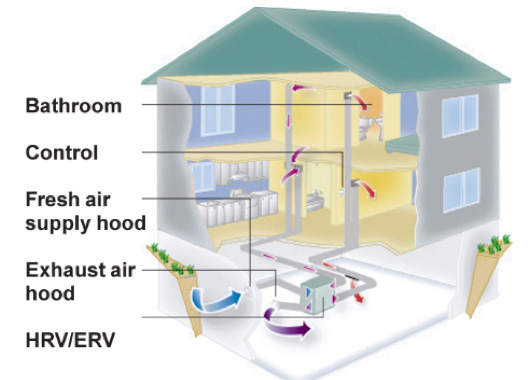
Independent System installation – Best
This application uses a devoted duct system for the supply and the exhausting of stale air accumulated in the home. It is recommended to install fresh air grilles in all bedrooms and living areas. Exhaust the stale air from the bathroom, kitchen and laundry room
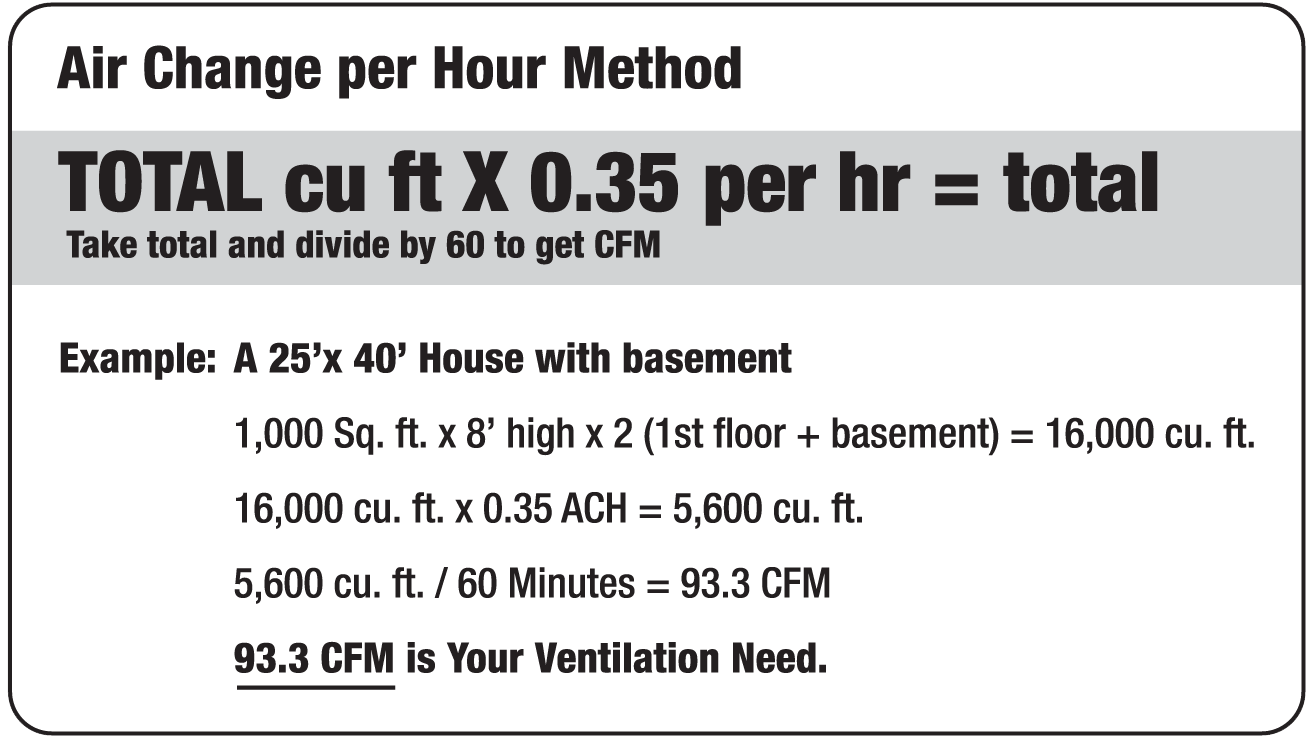
Maintenance and Troubleshooting
When should I service HRV/ERV?
WARNING: ALWAYS UNPLUG HRV OR ERV DURING SERVICING
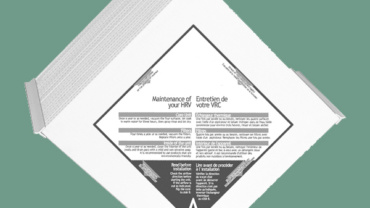
Heat/Energy Recovery Core Unit

Filters
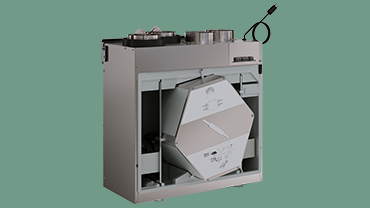
Inside the Unit
Problem & Solutions
Air Too Humid
- Reduce the humidity level on the controller
- Verify if dryer is venting in basement
- Verify if heating wood is stored in basement
- Wait for outside temperature to change. Example: Summer can be extremely humid
- Verify balancing of the HRV/ERV

Air Too Dry
- Increase humidity level on dehumidistat
- Switch ventilation mode from continuous to intermittent
- Install an Fantech humidifier
HRV/ERV Not Running
- Verify polarization
- Verify breaker in electrical box
- Verify that dehumidistat or switch on HRV or ERV are activated to supply power to unit
- Unplug HRV or ERV verify if controller is wired correctly to the connection box on the side of the unit
- Verify low voltage box (Duotrol™) on the unit
Frequently asked Questions
This guide has been established to help the homeowner in getting the most out of his Greentek HRV/ERV.
1- Balanced Ventilation
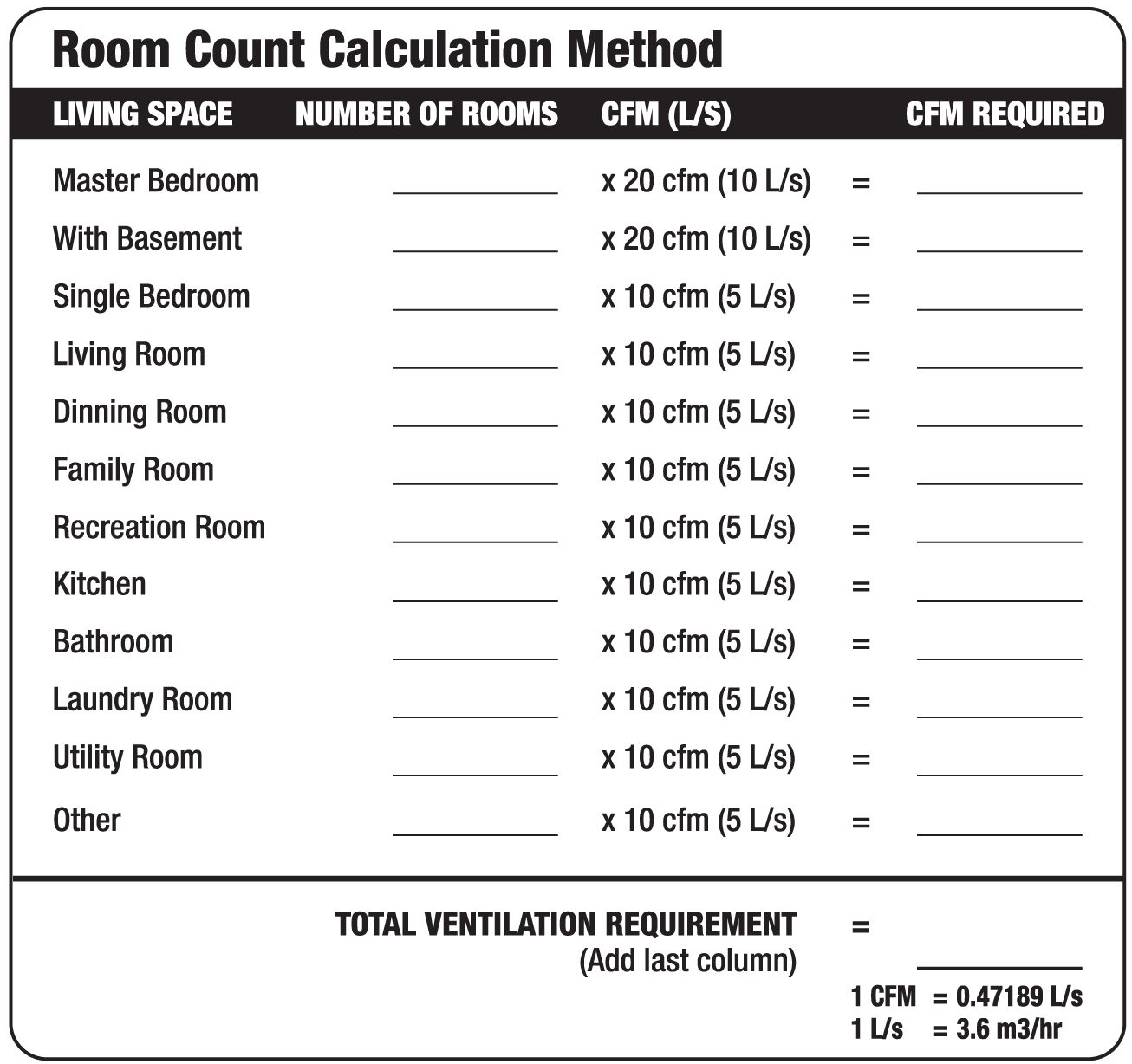
Ventilation requirements are measured in cubic feet per minute (CFMs) of air. There are several ways to determine the right amount needed. Some rely strictly on the size of the home; others rely on the number of rooms.
The Room Count Calculation or the Air Change per Hour method shows you how to determine your ventilation needs.
The American Society of Heating, Refrigeration and Air-Conditioning Engineers (ASHRAE) recommend a 0.35 air exchanges per hour for residential use.
Note: Always consult your local building code for minimum ventilation requirements.
Yes. This is the simplest method of installation when adding an HRV/ERV to an existing HVAC system.
Wiring diagrams and schematics are included in the installation manual. The schematics and wiring diagrams are explained in the installation manual.
Note: When the HRV/ERV is tied in to the forced air system, it is important that they run simultaneously.
Improvements in home building techniques have lead to homes being more and more airtight. Although this dramatically improved energy efficiency, it eliminated natural ventilation that occurred when air freely seeped in and out.
As all humans need fresh air, so does your home. Mechanical balanced ventilation will provide fresh air, while exhausting indoor pollutants varying from dangerous argon gasses to annoying cooking smells. It also provides a great defense against mold and excess humidity.
2- General information
Heat recovering ventilators (HRV) and energy recovering ventilators (ERV) are air-exchanging systems that reduce energy consumption when heating or cooling. The mechanical devices, equipped with fans (excluding passive units), are designed to improve air quality and help control interior humidity by drawing in fresh air while exhausting stale indoor air. The HRV is a compact unit that conditions the temperature of the outside air, while the ERV is a packaged unit that conditions both the temperature and humidity of the outside air. Because these units condition the air before it enters the home, your energy costs remain stable. This concept offers the air quality only Mother Nature can provide with efficiency levels for the 21st century.
The HRV and ERV both ventilate, the difference is in the heat-recovering core. The HRV is equipped with a polypropylene core while the ERV has a paper core. Both cores transfer sensible heat while the ERV core also transfers latent heat (humidity transfer).
The choice of an HRV and an ERV depends on the climate. The general rule is ERVs are better suited for warmer climates (Air condition more than heating) and HRVs are for colder climates.
3- Product Information
When choosing an HRV/ERV, 4 things should be considered: Capacity, efficiency, application and cost.
All Greentek and certifies HRV/ERVs are tested by the Home Ventilation Institute (www.HVI.org).
All testing procedures have been developed by HVI in order to test all aspects of an H/ERV.
4- Humidity Control
An HRV/ERV controls humidity to a certain extent. Humidity can be created many ways inside the house. Whether it be cooking, showering or simply exhaling, humidity levels can increase indoors. Ventilation will help lower the humidity by exhausting the air while drawing in the outdoor fresh air.
That said, if the air outside were more humid than the air inside, the HRV would not be able to decrease the amount of moisture contained in the indoor air.
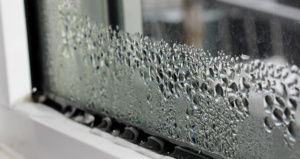
Condensation happens when air gets cooled below its dew point. The air is no longer capable of holding moisture, so the water condensates. This normally occurs around windows because they are less insulated, therefore cooler in winter months.
Proper ventilation will reduce humidity in winter, along with constant air circulation. This will reduce condensation on the windows.
5- Operating your HRV/ERV
Greentek offers a variety of controllers for added HRV/ERV functions. We also offer a timer designed to be installed in a bathroom. This timer activates high speed for a period of 20, 40 or 60 minutes for added humidity evacuation.
The humidistat activates high speed on the HRV/ERV. It should be set in the comfort zone during heating periods, and turned off during the summer.
The reason behind this is air tends to be more humid in the summer. If the air outside is more humid than the air inside, the HRV/ERV won’t be able to dehumidify.
Some Wall controllers have an LED light. An orange light indicates the unit is powered while a green light indicates the unit is in high speed.
An HRV/ERV is a mechanical ventilation machine required when natural ventilation isn’t available. If windows are left open during the summer, running the HRV/ERV is not necessary.
Re-circulation means that the HRV/ERV draws air from inside the house and re-distributes it. No outside air enters the house. This can be activated with the wall controls (EHC1.5 DC; RD-3D or RD-4D).
This feature can be useful on extreme cold days when fresh air isn’t needed. The heating load on your house will be reduced and that’s money in your pocket.
6- Efficiency terms for HRV/ERV’s
Apparent Sensible Effectiveness (ASE): The measured temperature rise of the supply air stream divided by the difference between the supply temperature (point 1) and exhaust temperature (point 3) and multiplied by the ratio of mass flow rate of the supply divided by the minimum of the mass flow rate of the supply or exhaust streams. This value is useful principally to predict final delivered air temperature at a given flow rate.
Sensible Recovery Efficiency (SRE): The sensible energy recovered minus the supply fan energy and preheat coil energy, divided by the sensible energy exhausted plus the exhaust fan energy. This calculation corrects for the effects of cross-leakage, purchased energy for fan and controls, as well as defrost systems. This value is used principally to predict and compare energy performance.
Total Recovery Efficiency (TRE): The total energy (enthalpy) recovered minus the supply fan energy and the preheat coil energy, divided by the total energy (enthalpy) exhausted plus the exhaust fan energy. This calculation corrects for the effects of cross-leakage and external purchased energy for fans and controls. It is used principally to predict and compare energy performance.
7- The Greentek Warranty
Note: Items not listed below, including accessories or non-Greentek items such as housings or brackets, carry a one year limited warranty.
- LIFETIME LIMITED WARRANTY ON POLYPROPYLENE HEAT RECOVERY CORE
- Greentek warrants the polypropylene heat recovery core against defects in material and workmanship for a lifetime from the date of original installation. Greentek will provide a new or remanufactured part, at its own discretion, to authorize replacement of defective part, without charge for the part itself.
- 5-YEAR LIMITED WARRANTY ON RESIDENTIAL ENTHALPY ENERGY RECOVERY CORE
- 3-YEAR LIMITED WARRANTY ON LIGHT COMMERCIAL ENTHALPY ENERGY RECOVERY CORE
- Greentek warrants the enthalpy energy recovery core against defects in material and workmanship for a period of five years from the date of original installation. Greentek will provide a new or remanufactured part, at its own discretion, to authorize replacement of defective part, without charge for the part itself.
- 7-YEAR LIMITED WARRANTY ON RESIDENTIAL ERV/HRV FAN MOTORS
- 3-YEAR LIMITED WARRANTY ON LIGHT COMMERCIAL ERV/HRV FAN MOTORS
- 5-YEAR LIMITED WARRANTY ON RESIDENTIAL ELECTRICAL COMPONENTS
- 3-YEAR LIMITED WARRANTY ON LIGHT COMMERCIAL ELECTRICAL COMPONENTS
- 5-YEAR LIMITED WARRANTY ON HEPA FILTRATION SYSTEMS
Limited Factory Warranty
This warranty supersedes all prior warranties
Except as expressly stated in this agreement, there are no warranties, express or implied, by operation of law or otherwise. Greentek disclaims the implied warranties of merchantability and fitness for a particular purpose as to both Greentek and non-Greentek products.
Greentek’s warranties extend to its customers and its end users. Greentek will not be liable for any incidental, indirect, special, or consequential damages, including, but not limited to, loss of use, revenues, profits, or savings, even if Greentek knew or should have known of the possibility of such damages.
During the entire warranty period:
Greentek warrants that Equipment sold to its account holders will be free from defects in material and workmanship during the Warranty Period. If a factory defect is detected, the product needs to be returned to the distributor where it was purchased from. On claims issued by Greentek account holders, Greentek will repair or replace any part that has a factory defect in workmanship or material. If necessary, return this product to the Greentek factory together with a copy of the bill of sale, identified with the return materials authorization (RMA) number. “Warranty Period” means the period stated to be as such from the table below.
For factory return, you must:
- Have a Return Materials Authorization (RMA) number,
- Have the bill of sale available,
- All parts and/or products returned must be shipped prepaid back to the buyer, and
- Write the RMA number clearly on the outside of the carton.
If all these conditions above are not met, the carton will be REFUSED.
Then:
Once these conditions are met, all parts and/or products will be repaired/replaced and shipped back to the user; no credit will be issued.
OR
The Distributor may place an order for the warranty part and/or product and is invoiced. The Distributor will receive a credit equal to the invoice only after the product is returned prepaid and verified to be defective.
Greentek warranty terms do not provide for replacement without charge prior to inspection for the defect. Replacements issued in advance of defect inspection are invoiced, and credit is pending inspection of returned material. Defective material returned by end users should not be replaced by the distributor without charge to the end user, as a credit to the distributor’s account will be pending inspection and verification of the actual defect by Greentek.
Equipment Warranty and Disclaimers
- Subject to conditions (2) through (7) below, during the Warranty Period, Greentek will repair or replace any defective item of Equipment or part or component of Equipment, promptly sent to Greentek by Customer, which Greentek determines was defective due to faulty material or workmanship.
- This Warranty is void if the Greentek label control number or date of manufacture, which is affixed to the Equipment, has been removed or altered in any way.
- While necessary maintenance or repairs on your Greentek product can be performed by any company, we recommend that you use licensed personnel only. Improper or incorrectly performed maintenance or repair voids this Warranty.
- This Warranty does not apply to damage occurring after Greentek has delivered the Equipment to a shipper. If damage, whether concealed or visible, has been caused by shipping, the Customer must file a claim with the freight company.
- This Warranty does not apply to damages resulting from improper wiring or installation, or resulting from improper consumer procedures such as lack of proper maintenance, unlicensed work, misuse, abuse, abnormal use, use by an application other than one recommended by Greentek, or accident or application of incorrect electrical voltage or current.
- This Warranty does not apply to damage or failure caused by any cause beyond the control of Greentek, including acts of God, war, terrorism, riot, or insurrection.
- Any other warranty, expressed, implied, or written, and to any consequential or incidental damages, loss or property, revenues, or profit, or costs of removal, installation, or reinstallation, for any breach of warranty.
Warranty Validation
- The user must keep a copy of the bill of sale to verify purchase date.
- These warranties give you specific legal rights, and are subject to an applicable consumer protection legislation. You may have additional rights which vary from state to state.
Limitation of Warranty and Liability
This warranty does not apply to any Greentek product or part which has failed as a result of faulty installation or abuse, incorrect electrical connections, or alterations made by others, or use under abnormal operating conditions or misapplication of the product or parts. We will not approve for payment any repair not made by us or our authorized agent without prior written consent. The foregoing shall constitute our sole and exclusive warranty and our sole exclusive liability, and is in lieu of any other warranties, whether written, oral, implied, or statutory. There are no warranties which extend beyond the description on the page hereof. In no event, whether as a result of breach of contract, or warranty or alleged negligence, defect incorrect advice or other causes, shall Greentek be liable for special or consequential damages, including, but not limited to, loss of profits or revenue, loss of use of equipment or any other associated equipment, cost of capital, cost of substitute equipment, facilities or services, downtime costs, or claims of customers of purchase for such damages. Greentek neither assumes or authorizes any person to assume for it any other liability in connection with the sale of product(s) or part(s). Some jurisdictions do not allow the exclusion or limitation of incidental or consequential damages so the above limitations and exclusions may not apply to you.
Warning
Greentek products are designed and manufactured to provide reliable performance, but they are not guaranteed to be 100% free from defects. Even reliable products will experience occasional failures and this possibility should be recognized by the user. If these products are used in a life support ventilation system where failure could result in loss or injury, the user should provide adequate backup ventilation, supplementary natural ventilation, failure alarm system, or acknowledge willingness to accept the risk of such loss or injury.
8- HRV/ERV Maintenance
Filters can be cleaned with a vacuum or wash. We recommend cleaning them four times a year.
Hint: The filter on the intake side (left side) will accumulate more dirt than the exhaust filter. To extend their lives they can be swapped after a certain period of time.
Once a year or as needed, vacuum all 4 sides and soak in warm water for 15 minutes. Then Rinse the core with shower head or hose without scrubbing. Then let it either air dry or use a hair dryer. If you clean your core during the cold season, please make sure that the core is completely dry before reinstalling.
Inside of the cabinet should be washed using a damp cloth and mild non-abrasive soap. We recommend using an environmentally friendly cleaner.
Greentek HRV/ERV are equipped with sealed motors. No preventative maintenance is required on any mechanical part. The home owner must only assure that the unit is clean.